
Bullying in the Classroom
Bullying can occur in just about any environment. Below you will find some of the best evidence-based resources available for addressing bullying in the classroom.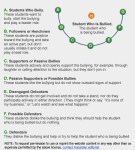
- How Bullying Affects Children
- How to Recognize Bullying
- A Violence/Bullying Prevention Program That Works!
- Research based comparison of Violence Prevention Programs
Hamarus Study abstract “Results and Conclusions” below:
Results: Our study suggested that bullying behaviour consists of short communicative situations which are often hidden from teachers. These separate situations account for the subjective experience of bullying. Bullying behaviour is a way of gaining power and status in a group or school class.
The status is maintained by calling a pupil who is bullied different names. The ‘difference’ in the bullied pupil is interpreted as a culturally avoidable characteristic.
In this way, bullying behaviour creates cultural norms and forces all pupils in the bullying community to follow them. Telling stories and calling the bullied pupil names increases the group’s cohesion and the treatment of the bullied pupil creates fear in other pupils, who do not dare to fight bullying. In a community where bullying occurs, fear and guilt are obvious.
Conclusions: Bullying is embedded in cultural norms, values and social status in the whole community. The hidden nature of the phenomenon emerges in short communicative situations that should be taken seriously.
This research applies an approach from sociology and cultural studies to an area that has been dominated by psychological approaches. In doing so, it opens up a variety of interpretations of what bullying is and how it develops in schools.

 LifeWorks Counseling Services